Hex 1: Starting with a City
 Alt text:
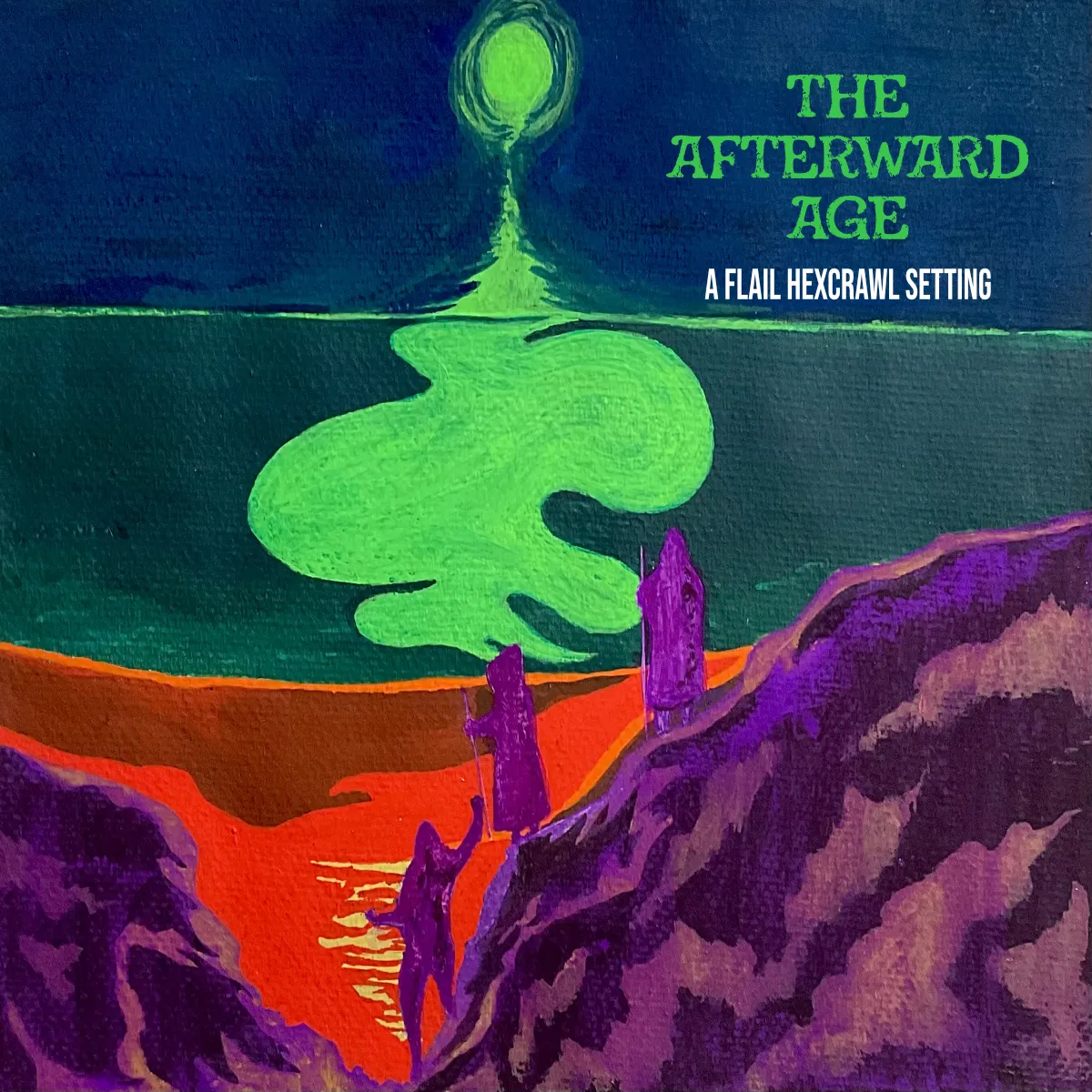
Illustrated cover art for The Afterward Age, showing a surreal post-apocalyptic landscape. A glowing green rift or sun hangs in a dark blue sky, spilling luminous green energy down into a winding river. Purple rock formations and ruined stone towers rise from red and orange terrain in the foreground. Title text reads “The Afterward Age – A FLAIL Hexcrawl Setting.”
Alt text:
Illustrated cover art for The Afterward Age, showing a surreal post-apocalyptic landscape. A glowing green rift or sun hangs in a dark blue sky, spilling luminous green energy down into a winding river. Purple rock formations and ruined stone towers rise from red and orange terrain in the foreground. Title text reads “The Afterward Age – A FLAIL Hexcrawl Setting.”
Art by Perplexing Ruins
Hex 1 is a city because I wanted a city.
That’s it.
Big, strange cities in fantasy games give players density, friction, and immediate decisions. People know how cities work, so a city is an intuitive starting point. You only need to show how this city behaves differently.
So Hex 1 is the city, Ramat Malle, the Closed Spectrum.
Ramat Malle appears welcoming at first, offering supplies, work, and safe shelter. At the same time, all actions are monitored; every transaction is logged, every engagement observed by discreet city officials.
Even the magic is registered and tightly audited. Colors seem desaturated as if the city alone restricts vibrancy. Any individuality or spontaneous behavior is addressed, making the city feel curated, almost unnervingly controlled.
That tension between recognizable and uncomfortable does a lot of work without explanation.
Why It’s in the First Hex
Putting the city in Hex 1 means players don’t have to earn access to something stable before things get weird. They start with something solid, then step outward into instability.
That matters in a hex crawl. If everything is strange right away, nothing stands out. A strong, clear reference point makes the surrounding chaos easier to read and react to.
Ramat Malle is there to be used, avoided, or eventually pushed against.
Authority You Can See
The Church is present here because it needs to be obvious who and what the Authority is, and it gives the PCs something to root against or possibly join.
Hammer-Priests do not hide; they patrol streets in pairs, their faces veiled, wielding ceremonial hammers. Laws are posted on city walls. Every transaction and interaction is tracked by officials in uniform. When someone breaks the rules, consequences follow quickly: fines, interrogations, or public corrections.
Authority is active and alert; players see its presence in every part of city life.
What does this give the Crawl?
Starting with a city gives me a few things I want right away:
- A familiar structure that players are capable of moving through.
- Immediate access to rumors, jobs, and pressure.
- A baseline for what “order” looks like in this world
The weirdness comes later, when players realize how much that familiarity is costing them.